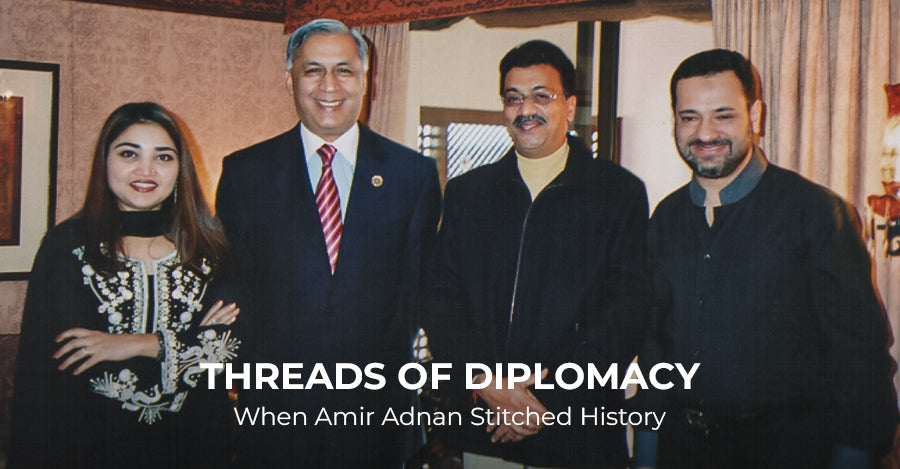
Threads of Diplomacy: When Amir Adnan Stitched History
How often does a designer’s creation become a diplomatic headline? How often does a sherwani become a symbol of peace? Welcome to another riveting chapter in the royal chronicle of Amir Adnan — the man who didn’t just tailor garments; he tailored moments in history.

The Man Behind the Monarchs
By now, the name Amir Adnan needs no introduction. The pioneer who resurrected the sherwani from royal vaults and paraded it onto modern runways, Amir is Pakistan’s answer to timeless craftsmanship and cultural reinvention. With threads spun from heritage and innovation, he didn’t just design clothes — he redefined identity.
Born into the illustrious Dhaka Nawab family on January 23, 1965, Amir Adnan’s lineage reads like a page from a Mughal manuscript. His great-grandfather, Nawab Sir Salimullah, founded the All-India Muslim League, a historical stitch of his own. So perhaps it’s no surprise that Amir’s journey would also weave together nations, traditions, and timelines in a single seam.

When History Knocked on the Atelier Door
It was January 2004. Amidst political handshakes and security briefings, a rather poetic request came from the Indian Prime Minister, Atal Bihari Vajpayee, during his visit to Pakistan. He had wished to don a Pakistani sherwani. Not just any sherwani but one echoing the iconic collar embroidery of Zulfikar Ali Bhutto’s attire from 1970.
In the age of border tensions, that request was as rare as a snowflake in the Sindh desert.
At dawn, the call came. “The Indian Prime Minister needs your designs,” said then–Finance Minister Shaukat Aziz. Amir and Huma Adnan rushed to the ministry with their finest pieces in tow, unsure whether they were designing for diplomacy or destiny.

The Sherwani That United Two Nations
Vajpayee, known for his poetry and grace, was particular. “Fine embroidery,” he said, “on a white collar, in black — like Bhutto’s.” It wasn’t about fashion; it was about memory. About a shared cultural elegance that transcended politics.
And so, Amir Adnan began crafting not just a sherwani, but a story of unity stitched in silk and Kashmiri thread.
"He didn’t stop at one. Or even two. He designed an entire wardrobe: four exquisite sherwanis, shalwar-kameez sets, and waistcoats — a gift of friendship. He refused payment, calling it “a gesture of goodwill, stitched from the heart.”
From Runway to Run of Honour
Suddenly, Amir Adnan wasn’t just Pakistan’s leading designer, he was its cultural ambassador in couture. From Musharraf’s bilateral talks in Agra to the red carpets of Dubai and the Golden Globes, his designs blurred borders and built bridges.
Amir’s artistry has since crossed borders, continents, and red carpets. From Dubai Fashion Week to Fashion Pakistan Week, his designs have graced everyone from global icons like Camryn Howard (who wore Amir Adnan at the Black Panther premiere and Golden Globes) to legends like Keith Sweat, Iqbal Theba, and Don Benjamin.
But behind the glamour lies grit. Amir Adnan’s wardrobe of fame was built not merely on fabric, but on faith — faith in Pakistani craftsmanship, in cultural revival, and in the sherwani as the East’s proud armor.

Accolades, Achievements, and a TED-Talk Triumph
His accolades read like milestones of mastery: Pride of Performance (2006), twice winner of the Lux Style Award for Best Menswear Designer, and TEDx speaker whose talk on revolutionizing fashion left audiences spellbound.
As a founding member of the Fashion Pakistan Council, twice its CEO, and a board member at the Pakistan Institute of Fashion Design, he became the mentor every young designer wished to learn under. Always the visionary, always the vanguard.

Stitches of Peace, Seams of Legacy
That fateful day when Vajpayee wore an Amir Adnan sherwani, the world didn’t just witness a political visit, it witnessed a statement: that even amidst divisions, culture can connect. As hands shook and threads intertwined, so did goodwill.
Today, three decades on, the House of Amir Adnan stands as a living testament to timeless artistry — proof that a needle can mend more than fabric; it can mend nations.